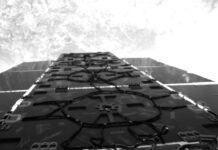

Xona Space Systems announced Thursday it closed an oversubscribed $170 million Series C funding round to speed deployment of its Pulsar satellite constellation and scale manufacturing.
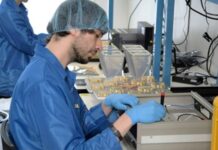
The round was led by Mohari Ventures Natural Capital, with participation from Craft Ventures, ICONIQ, Woven Capital, NGP Capital, Samsung Next, Hexagon and additional new and existing investors. The capital will fund rapid satellite production at the company’s new factory in Burlingame, Calif., and support global expansion, including team growth in Montreal and London, the company said.
Xona’s Pulsar service broadcasts from low-Earth orbit satellites flying 20 times closer to Earth than traditional GPS, delivering signals 100 times stronger with military-grade encryption, the company said. It provides centimeter-level accuracy and resilience against jamming and spoofing while remaining compatible with existing GPS receivers, requiring no new hardware.

Co-founder and CEO Brian Manning said the funding validates strong market demand for navigation infrastructure suited to the era of physical AI, precision agriculture and advanced defense applications. “GPS has been foundational to modern life, but it was designed for a different era,” he said. “This funding validates that the market is ready, the demand exists, and Xona is ready to deliver.”
Investor Jay Zaveri of Mohari Ventures highlighted Pulsar’s advantages over legacy GNSS systems, noting that American farmers currently rely on Russian and Chinese satellites because GPS signals are too weak and vulnerable.
Early Pulsar commercial coverage is expected as soon as 2027, with the full 258-satellite constellation targeted for rapid deployment through modern manufacturing that aims to produce more satellites per week than the U.S. government currently builds in a year.
Advanced Navigation Raises $110 Million to Scale GPS-Denied Navigation for Autonomous Systems
In other industry financial news, Australia-based Advanced Navigation announced last week that it secured $110 million in Series C funding to accelerate development of resilient, GPS-independent systems amid rising global threats to satellite-based navigation from jamming and spoofing.
The round was led by Airtree Ventures, with participation from Quadrant Private Equity and Australia’s National Reconstruction Fund Corporation, joining existing investors including Main Sequence, KKR, In-Q-Tel, Alpha Intelligence Capital, former Australian Prime Minister Malcolm Turnbull and OIF Ventures.

The company’s differentiating technology centers on a “Hard Tech” approach combining high-precision inertial hardware — such as fiber optic gyro-based systems like the Boreas series for ultra-accurate orientation and position — with AdNav Intelligence, its AI-driven software fusion engine that integrates multi-sensor data in real time to deliver centimeter-level accuracy in GNSS-denied or contested environments, including underground mines, underwater operations, defense scenarios and space missions.
CEO and co-founder Chris Shaw said the funding will scale high-precision inertial navigation with onboard intelligence, evolve AdNav Intelligence for adaptable, mission-specific sensor fusion, rapidly deploy across maritime, mining, defense and space sectors. “The era of relying on a single silver bullet for navigation is over,” Shaw said. “The future belongs to intelligent systems that can sense, adapt, and navigate independently.”