
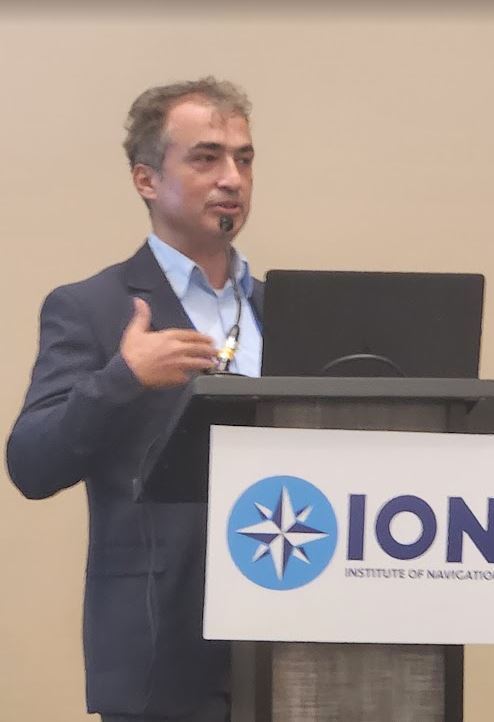
ORLANDO, Fla. — Airline pilots and navigation safety researchers warned at the ION GNSS+ 2026 conference that satellite spoofing has evolved from a regional nuisance into a global aviation “disease,” tricking aircraft hardware into issuing false terrain alerts at 41,000 feet and eroding trust in cockpit systems.
During a panel titled “Aviation PNT Risks and Resilience: Experience from the Cockpit,” aviators presented video evidence from an Airbus A350 flight showing onboard systems becoming completely confused mid-flight due to corrupted position, navigation, and timing (PNT) data. Panelists noted that interference originating near conflict zones and Eastern Europe—particularly around the Baltic states and Poland—has expanded worldwide, creating cascades where spoofed signals cause aircraft traffic collision avoidance and terrain systems to issue high-priority pull-up commands at cruising altitudes.

“It is a disease on a global level,” said Cpt. Mark Walton, an Airbus pilot with Air Arabia and Fellow of the Royal Aeronautical Society, calling for unambiguous cockpit alerts and automated backup systems. “Pull back stick at 41,000 feet is a completely incorrect response, but pilots are indoctrinated to respond to instruments. All the things in the cockpit are designed for this reaction—something needs to light up, but we need a system that remains available to us.”
Walton recounted a real-world incident where an Emirates flight encountered spoofing on a route from Europe to Dubai; even after ground reset procedures in Dubai, the aircraft’s multimode receiver retained corrupted data on its subsequent leg to Sydney.
Experienced flight crews stressed that expecting pilots to perform manual data cross-checks while managing conflicting alerts during critical flight phases is unrealistic.
“Drinking your coffee, a ‘pull up’ warning makes no sense, but the situation dictates to climb, so they do it,” said Cpt. Berna Sen, a Ryanair Boeing 737 pilot and former Turkish Air Force F-16 aviator with 30 years of flight experience. “Operational procedures from the ESA or Boeing don’t tell us what to do when we have seconds to react. You don’t have enough time overthinking it at low altitudes.”
Engineers acknowledged a persistent gap between theoretical safety models and real-time cockpit operations, emphasizing that civil aviation standards are significantly harder to mandate than military protocols.
“We develop requirements in theory as researchers, but they are encountering it in real time,” said Dr. Evan Dill, a NASA researcher. “Incredible justification exists for this panel because information we don’t think is valuable as engineers is valuable to them.”
A central challenge remains the lack of a single governing authority capable of mandating anti-spoofing standards across international airspace and private original equipment manufacturers, leaving airlines to bear the cost of retrofits.
“Someone needs to define the options and someone should be in charge, but there isn’t,” said Dr. Bradford Parkinson, who advocated for automated software filters. “A good spoof detector should automatically revert the system to the way it was before.”