
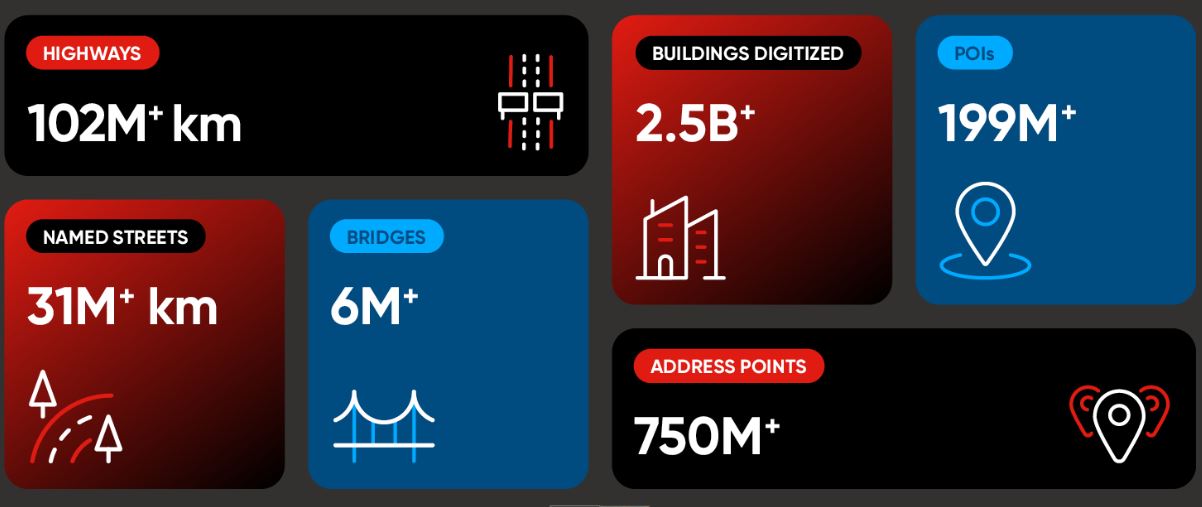
TomTom’s Orbis Maps, which was launched in late 2023, has been the backbone product of a company that has recently seen both highs and lows in its revenue.
The growth of Orbis Maps is good news for Dutch mapmaker TomTom, which recently announced it was laying off 300 employees. The company this week also announced that it will lift the bottom end of its 2025 revenue guidance—after a better than expected performance in the second quarter—primarily in its automotive business.
To highlight the growth of the company’s main mapping product, Location Business News recently interviewed Willem Strijbosch, TomTom vice president of product for Maps and Search.
LBN: So far, Orbis Maps has expanded rapidly. What do you see as the main driver behind this growth?
Strijbosch: “Orbis Maps was built from the start to be a collaborative, open mapping platform combining proprietary and open data. Its rapid expansion is driven by a combination of strong industry partnerships, integration with Overture and the OpenStreetMap communities, and a design that enables continuous, AI-powered updates. This approach ensures the map is always evolving with richer, fresher, and more accurate data that meets the needs of diverse industries globally.”

LBN: Government markets seem to be a solid growth area. What ways does Orbis Maps assist transportation managers in planning?
Strijbosch: “Orbis Maps supports government and public sector agencies with highly detailed, real-time data that can be used for planning related to mobility, infrastructure, and public safety. Its compatibility with widely adopted formats like Esri’s File Geodatabase (FGDB) enables seamless integration into ArcGIS applications, making it easier for transportation managers to visualize road conditions, conduct spatial analysis, and make informed decisions efficiently.”
LBN: What future growth areas do you see for Orbis Maps?
Strijbosch: “We recently announced 3D lane geometry for any road, enabling automated driving and immersive navigation. By continuing to map the world with unmatched coverage and AI-powered precision, Orbis Maps can better support the fast-paced growth of industries like automated driving and smart city planning. The focus remains on increasing both data richness and accessibility, enabling users across sectors to make smarter, faster, and more strategic decisions.”