
Worldwide GPS jamming and spoofing is only going to get worse before before solutions are found to mitigate the tremendous risks to world safety. Location Business News recently spoke to Advanced Navigation’s Chris Shaw, CEO and co-founder, about the company’s efforts to improve GNSS signal strength.
LBN: How does Advanced Navigation’s Hybrid Navigation System work to improve GNSS signal strength when in jamming and spoofing, cyber threat environments? Are you in tests right now?
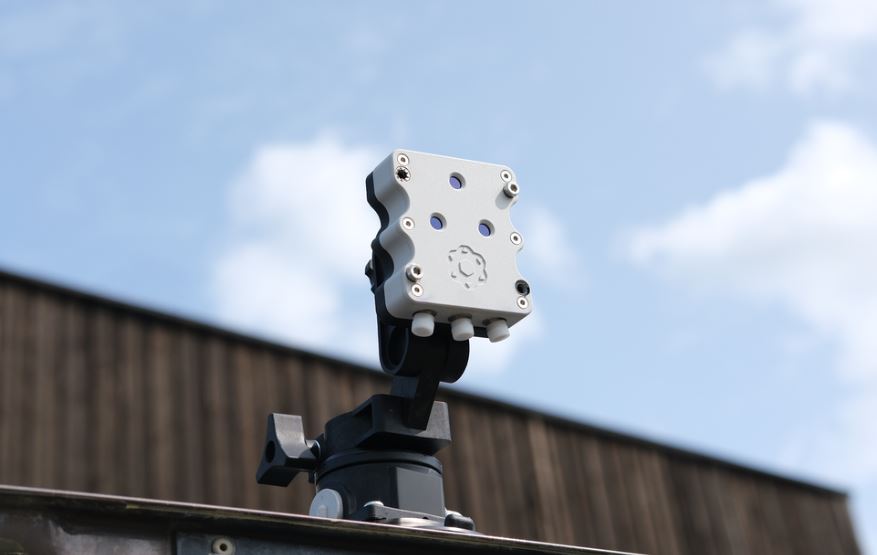
Shaw: The Hybrid Navigation System integrates Boreas, a strategic-grade fiber-optic gyroscope (FOG) inertial navigation system (INS), with the Laser Velocity Sensor (LVS). The result is an inertial-centered, multi-sensor approach that delivers a step-change in GNSS-denied navigation performance, compared to traditional methods.
While GNSS on the INS can be added as an optional input to obtain heading or positioning information, it is not mandatory. The Hybrid Navigation System is capable of delivering precision navigation without any reliance on GNSS, allowing it to successfully operate in environments where spoofing and jamming is occurring.
The Hybrid System further enhances navigation resilience by detecting GNSS spoofing – this is achieved by the LVS comparing its independent velocity measurements against GNSS-derived velocity.
Advanced Navigation recently demonstrated the Hybrid Navigation System in a live streamed trial at the Callio Pyhäjärvi underground test mine in Finland. The system successfully delivered infrastructure-free, high-precision positioning in Europe’s deepest underground mine.
This was part of a roundtable activity led by Think & Act Differently (TAD), BHP‘s innovation team. TAD’s Deep Mining Open Call aimed to identify innovators with capability that could be applied to deep underground mining.
In the coming weeks, Advanced Navigation will be releasing a technical whitepaper highlighting the livestreamed results.

LBN: Using phased array ultra-wideband (UWB) and Bluetooth Low Energy (BLE), Advanced Navigation recently tracked smartphone locations within 10–30 centimetres, without relying on GPS. Will there be other tests of this technology and how will it be integrated into the company’s GNSS product line, if at all?
Shaw: The pilot was delivered under the Small Business Innovation & Research Program (SBIR), administered by the Office of the NSW Chief Scientist & Engineer and involved further collaborative efforts from Transport for NSW, Sydney Metro and University of Technology Sydney.
This pilot demonstration is a powerful example of taking our core navigation technology and creatively applying it to a high-impact, real-world problem. While this marks the conclusion of the program, we’re excited to see how the insights gained may inform future innovation. We are working with our partners to review where this technology could deliver the most value, and welcome new opportunities to apply it in environments where GPS is unavailable – from underground tunnels and transit hubs to mines, remote industrial sites, and dense urban areas. Like any innovation, it’s part of an ongoing process of evaluation and refinement.
LBN: Is the indoor testing solely concentrating on vision-impaired people?
Shaw: The challenge posed by SBIR is to develop proofs of concept for a hyperlocal navigation technology. While the goal was to assist passengers with vision impairments to access public transport services, the Indoor Positioning Technology has benefits for any commuter who takes public transport and relies on a smartphone to navigate underground stations.