America’s family farms, the bedrock of rural communities and national food security, are teetering on the edge of obsolescence without bold intervention from President Donald Trump, experts warn. Advocates urge a sweeping national action plan to harness precision agriculture technologies, with GPS-guided systems at the forefront, to slash costs, boost yields and empower small operators against mounting financial headwinds.
Lisa Dyer, executive director of the GPS Innovation Alliance, outlines a forward-looking plan to seed America’s high-tech farming future by prioritizing congressional action on rural broadband expansion and increased financing for precision agriculture tools. “Developing an action plan doesn’t cost the government anything except time, and the investment would be worth it for America’s farmers,” she said.

Dyer pointed to the administration’s AI Action Plan as a model, calling for a similar whole-of-government road map to bring precision agriculture — led by GPS-guided systems — to small and midsize operations struggling with high interest rates, thin margins and the lack of rural broadband. “America’s farmers would benefit from a similarly coordinated, national approach that continues to allow them to bring the food they grow to U.S. and global markets, particularly small and medium-sized farms that lack rural broadband and precision ag technologies,” she said. “Without equitable access, these smaller farms risk being left behind in an era where every acre must be maximized.”
Dyer noted that farmers have historically accessed USDA grant and loan programs to adopt precision tools, and the recent One Big Beautiful Bill included $65.6 billion in agriculture provisions and tax incentives that encourage precision ag for conservation goals. “What remains to be seen is whether Congress will pass a Farm Bill in 2026, which could include the language from the PRECISE Act and other precision agriculture-related bills,” Dyer said.
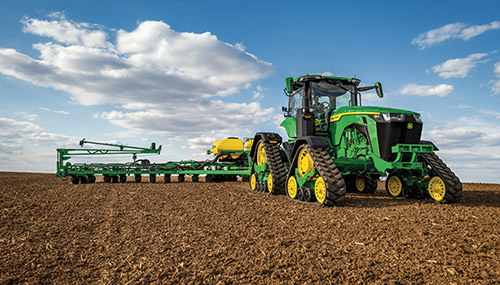
In a May op-ed, Dyer highlighted that only 27 percent of U.S. farms currently leverage these technologies, underscoring the need for federal incentives to bridge the gap and enable centimeter-accurate GPS systems for tilling, planting and spraying. Drawing on innovations from such GPSIA members as Deere & Company DE 0.00%↑ and Trimble TRMB 0.00%↑ — including sub-inch accuracy via RTX technology and autonomous tractors — her blueprint aims to accelerate adoption, boost yields, cut pesticide use and enhance food security, transforming family farms into efficient, sustainable powerhouses.