TomTom released a report Monday analyzing road congestion around 11 major U.S. airports during peak travel periods, including the November 2025 federal government shutdown and 2024-2025 holidays, drawing on multi-year data from 600 million connected devices to identify national trends and regional disparities in traveler access.
The analysis highlights that most airports experienced faster-than-normal traffic during the shutdown, with Boston Logan International Airport (BOS) posting the largest gains at 19% improvement in afternoon congestion, while commuter-focused hubs like Los Angeles International (LAX) and Houston’s George Bush Intercontinental (IAH) showed mixed results, including morning slowdowns of up to 12.5% at LAX.

Nationally, the 1-5 a.m. window emerged as the most reliable for smooth airport access, contrasting with peak congestion between 10-11 a.m. and 5-8 p.m., according to the report, which also found tourism-driven airports such as Las Vegas’ Harry Reid (LAS), Miami International (MIA), BOS and New York’s John F. Kennedy (JFK) often outperforming baselines during high-demand weeks.
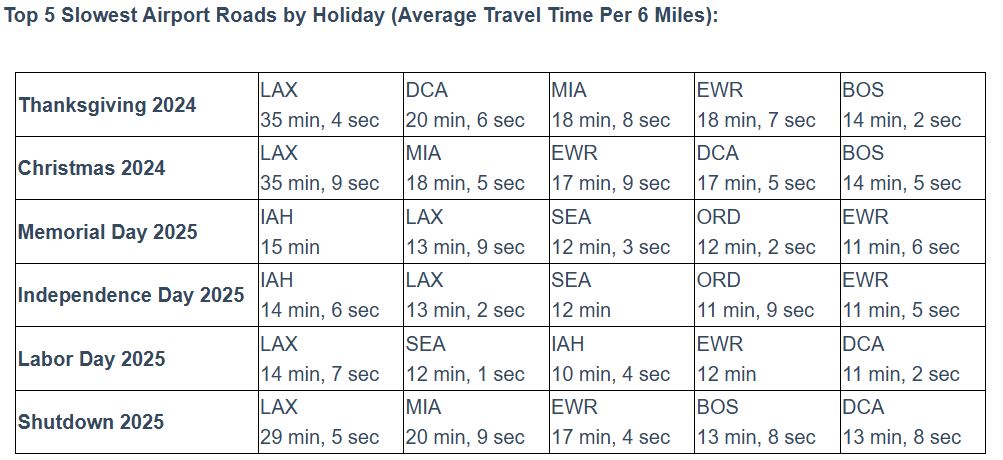
Holiday periods revealed stark regional divides, with summer 2025 events like Memorial Day showing half the airports improving 5-20% in travel times while others slowed 7-16%; Thanksgiving and Christmas 2024 amplified these gaps, as the slowest hubs like LAX took over 35 minutes per 6 miles—more than double the smoothest sites—compared to baselines.
“Airport access roads are one of the clearest indicators of how travelers respond to major events, whether it’s a holiday surge or a period of uncertainty like the November shutdown,” said Ralf-Peter Schäfer, TomTom’s vice president of product management for traffic and travel. The report concludes that local behaviors drive congestion more than seasonal factors, urging airports, transportation departments and planners to use the data for proactive adjustments to mitigate future bottlenecks.