
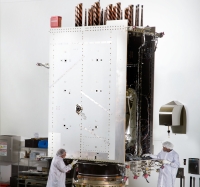
Photo: GPS III satellite (Lockheed Martin).
The U.S. Space Force is developing a long-term initiative known as Project Hecate to ensure the Global Positioning System remains survivable against evolving threats through the middle of the century, as first reported by Breaking Defense.
The effort focuses on creating a “hybrid” architecture that would allow military receivers to transition seamlessly between traditional GPS satellites and newer commercial or government constellations in low-Earth orbit. Officials said the program is a response to the increasing capability of adversaries to jam or spoof signals, which are vital for everything from precision-guided munitions to global financial networks.
While the current GPS III satellites offer enhanced security, Project Hecate looks past the next decade to integrate more resilient signal types and diverse orbital paths. By diversifying where and how positioning data is transmitted, the Space Force aims to make it nearly impossible for an opponent to disable the entire network during a conflict.
The program remains in its early conceptual phases, but it signals a shift in how the military views space as a contested domain. Engineers are currently evaluating how software-defined radios can be used to future-proof equipment against threats that do not yet exist.

GPS III satellite (Lockheed Martin).
Led by the Space Warfighting Analysis Center, Project Hecate involves analyzing layered architectures that incorporate multi-orbit, multi-frequency, commercial and international options to deliver resilient satellite navigation capabilities. The study, which is expected to wrap up this fall, will provide recommendations to the chief of space operations on architectures unconstrained by the current GPS setup, including shifts away from medium Earth orbit satellites and integration of advanced command and control systems.
A key element includes repurposing signals from proliferated low Earth orbit communications satellites through the center’s Space Data Networks reference architecture, allowing for rapid deployment of alternative positioning, navigation and timing sources at low cost. This approach leverages existing networks to counter jamming threats expanding into space, with modifications to user equipment like receivers and antennas rather than requiring entirely new hardware.